The Second Coming-of-Age of Humanitarian Leadership
From Appeals to Architecture — Why Resilience Is the New Credibility
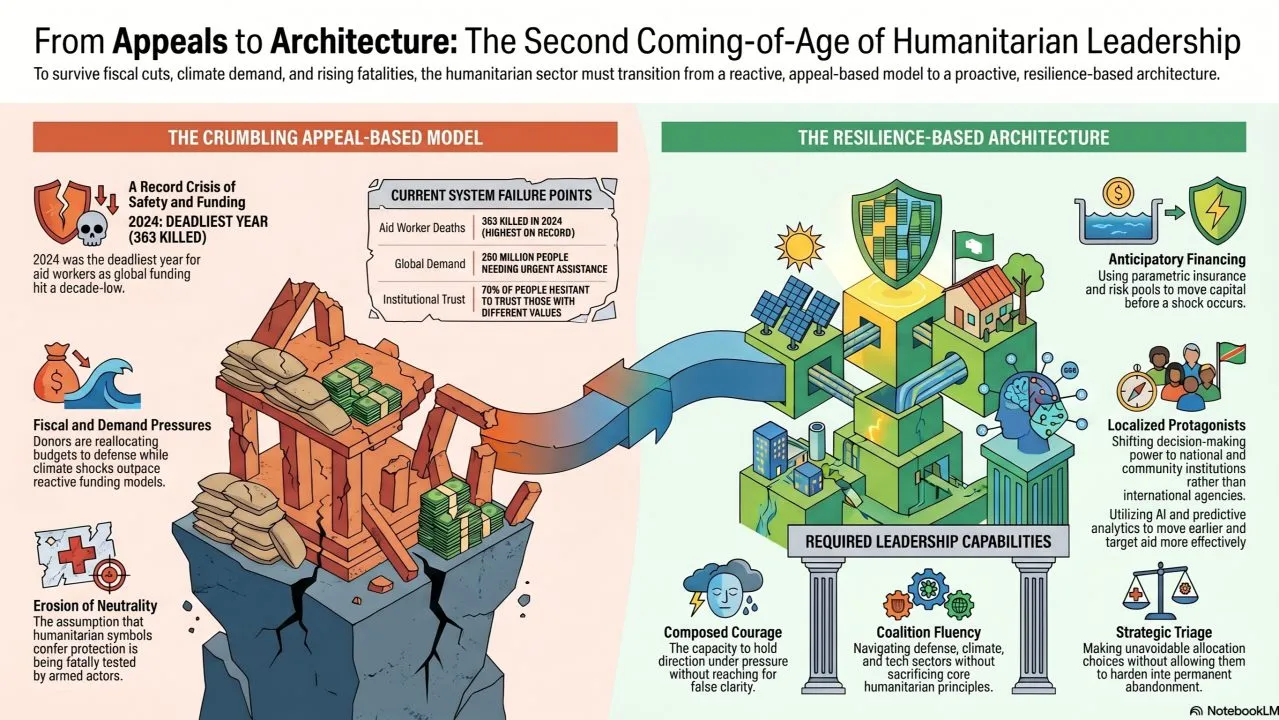
There are moments when a system reveals itself through the load it can no longer carry. This spring is one of those moments for the humanitarian sector. Famine has been formally confirmed in two theatres at once, Gaza and Sudan, for the first time in the modern era. More than 70 percent of Sudan’s hospitals have been destroyed. A quarter of a billion people now need urgent assistance. And against that demand, global humanitarian funding has fallen to its lowest level in a decade, while 2024 closed as the deadliest year on record for aid workers, with 383 killed in the course of their duties.
These are not separate facts. They are the same fact, observed from different angles. The model on which the modern humanitarian system was built, a model of post-crisis appeals, emotive narratives, Western donor generosity, and ad hoc scaling, is failing in slow motion. Not because humanitarian workers are less capable, or because donors are less moral, or because crises are less worthy of response. It’s not working because the architecture was designed for a different world.
The humanitarian sector is being asked, once again, to grow up. It has done this before. What follows is a reflection on why a second coming-of-age is now inevitable, what it will require of the leaders who guide the system through it, and why the organizations that lean into this transition will find that resilience is not a cost center but the source of their next-generation credibility.
The First Coming-of-Age
The humanitarian system most of us work in today is not the one founded by Henri Dunant in the nineteenth century. It is the one that came of age in the 1980s and 1990s, largely in response to the failures and lessons of that period.
Biafra, the Ethiopian famine, the post-Cold War complex emergencies in the Balkans, and, most of all, the collective failure in Rwanda forced the sector to confront hard questions about principles, independence, and accountability. The Sphere standards emerged. The four humanitarian principles, humanity, neutrality, impartiality, and independence, were codified in ways that became operational rather than merely rhetorical. Médecins Sans Frontières articulated a brand of principled intervention that changed the mental model of an entire generation of practitioners. OCHA was created. The Consolidated Appeals Process matured. The cluster system followed.
That first coming-of-age was a move from charity to profession. It established the field as a distinct domain of expertise, with doctrine, standards, and institutional seriousness. It also embedded an operating model that has carried the sector through the last thirty years: respond to crises as they occur, appeal to a relatively stable set of Western donors, scale operations on short-term funding, and trust that the international order will keep aid workers safe enough to operate.
That model worked because the world around it held together. Donor governments were politically willing and fiscally able. Conflicts, though tragic, were generally bounded. Climate volatility existed but had not yet become the organizing principle of humanitarian demand. And the assumption that humanitarian space would be respected by armed actors, however imperfectly, was one that leaders could still act on without self-deception.
None of those conditions can be assumed today.
Why the Appeal-Based Model Is Breaking
The pressures on the humanitarian system are often described individually, as if they were a sequence of bad years. They are not. They are a set of converging forces that, taken together, are dismantling the appeal-based model from multiple directions.
The first pressure is fiscal. The traditional donor base, a handful of OECD governments plus the European Commission, is reallocating its budgets toward defense, industrial policy, and domestic resilience. This is not a rhetorical shift. It is visible in the numbers. Aid budgets in several major donor capitals have been cut in absolute terms over the last two years, and the political incentive to reverse those cuts has weakened rather than strengthened. A humanitarian leader who expects the old funding base to return to its former trajectory is not being optimistic. They are being inattentive.
The second pressure is demand. Climate volatility is no longer a forecast. It is an operational reality. Frameworks now being published by institutions such as the Smith School at Oxford quantify how physical climate risk propagates through supply chain networks, producing systemic macroeconomic losses at a scale that will change what humanitarian demand even looks like. A super-El Niño developing through summer and autumn is expected to produce simultaneous flooding and drought across regions with no buffer. The compounding of climate shocks with protracted conflict means that, for the foreseeable future, humanitarian demand will rise in ways that appeal-based funding simply cannot track.
The third pressure is the protection of the humanitarian space. The record year for aid worker deaths is a signal, not an anomaly. It tells us that armed actors now calculate the reputational and operational costs of targeting humanitarians differently than they did a decade ago. The assumptions that underpinned the sector’s security model, that neutrality confers protection, that symbols have force, that institutional identity is itself a form of armor, are being tested in ways they have rarely been tested before.
The fourth pressure is institutional trust. The Edelman findings this year describe a global crisis of insularity, in which 70 percent of people say they are hesitant to trust those who differ from them in values or information sources. That matters for humanitarian leaders because our legitimacy depends on the belief that we act outside the circles of partisan interest. When trust in institutions of all kinds is retreating into tribal patterns, the universalist claim at the heart of the humanitarian system becomes harder to make credible without sustained effort.
And the fifth pressure is the quiet reorganization of humanitarian response itself. Bilateral donors are moving more resources through their own channels, rather than multilateral pooled funds. Faith-based actors are expanding their operational footprints. Private philanthropies, sovereign wealth funds from non-traditional donor states, and corporate actors are entering the space with different expectations about governance, visibility, and measurement. The sector is not being defunded so much as quietly restructured around it.
Put these together, and the conclusion is unavoidable. The appeal-based model is not collapsing because of a single failure. It is being outpaced, from every direction, by a world it was not designed for.
What Resilience-Based Systems Look Like
It is one thing to name the old model’s limits. It is another to articulate what a resilience-based humanitarian system actually looks like when it is built.
The simplest way to describe the shift is this. An appeal-based system asks, after the fact, how to mobilize resources in response to a crisis that has already occurred. A resilience-based system invests, before the fact, in the capacity to absorb, respond to, and recover from crises that have not yet arrived. The difference sounds subtle. In practice, it changes almost everything: how funding flows, where decision rights sit, which capabilities become strategic, and what kind of leadership is required to run the organization.
A resilience-based system is built on anticipatory financing. Parametric insurance, risk pools, catastrophe bonds, and drought-triggered disbursement mechanisms move capital before the shock, not after. The African Risk Capacity, the Southeast Asia Disaster Risk Insurance Facility, and the newer climate-linked instruments emerging from multilateral development banks are no longer experiments. They are the prototype of what dependable humanitarian finance will look like in the 2030s.
A resilience-based system is locally anchored. It treats national and community institutions as the primary responders and international agencies as enablers rather than protagonists. It invests in municipal crisis management, national disaster management authorities, and local civil society long before a crisis is declared. The Grand Bargain commitments, imperfect as they were, pointed in this direction. The next decade will determine whether the system is honest enough to act on them.
A resilience-based system is data-literate. It uses predictive analytics, remote sensing, and, yes, artificial intelligence, to move earlier, target better, and learn faster. It does this in ways that respect protection, dignity, and the humanitarian principles, which require leaders who can govern AI use inside their organizations, not merely procure it. This is where my work on AI exposure intersects directly with the humanitarian agenda. AI is not going to replace humanitarian judgment. It is going to reveal which humanitarian organizations ever had a coherent theory of judgment in the first place.
A resilience-based system is financially diversified. It builds relationships with non-traditional donors, Gulf philanthropies, Asian sovereigns, impact investors, and diaspora networks, without losing its principled independence. This is harder than it sounds. Every new donor relationship brings a new governance conversation, and some of those conversations will test the boundaries of the sector’s principles. Leaders who are unclear about their own red lines will find their organizations’ values drifting in ways they did not intend.
And a resilience-based system protects its people. It invests seriously in duty of care, psychosocial support, evacuation planning, and the security and well-being of staff who are increasingly operating in contexts where the old informal protections have eroded. The generation of humanitarian workers now entering the sector is unwilling to treat personal sacrifice as a cost of doing business, as the previous generation did. Nor should they.
The Leadership Capabilities the Pivot Will Test
A pivot of this magnitude is a test of leadership, not a test of strategy. The strategies are, in many cases, already visible. It is the capacity of leaders to act on them that is in short supply.
Three capabilities, in my experience, matter more than the rest.
The first is composed courage. The humanitarian leaders I work with often tell me that the hardest part of their job is not deciding what to do. It is remaining steady while the political, financial, and operational environment around them changes faster than their institutions can absorb. Composed courage is the capacity to hold direction under pressure, to tolerate uncertainty without reaching for false clarity, and to make the hard call without allowing the difficulty of the call to become an identity. In a world where humanitarian leaders will increasingly have to choose which programs to cut, which populations to deprioritize, and which principles to defend when others are willing to bend them, composed courage is the capability that will most distinguish the leaders who carry their organizations through this transition from those who merely survive it.
The second is the willingness to practice triage without allowing it to harden into abandonment. Every humanitarian leader in the system today is being asked to make decisions that would have been unthinkable five years ago, decisions about which famines to respond to, which conflicts to cover, and which populations to leave primarily to local actors. These decisions are unavoidable. What is avoidable is the quiet shift from triage, which is a temporary allocation under constraint, to abandonment, which is an implicit policy of withdrawal that nobody ever formally decided. Leaders who are clear-eyed about that distinction can make difficult choices without losing their moral compass. Leaders who blur it will find, five years from now, that their organizations have drifted into positions they would never have defended out loud.
The third is coalition fluency. The humanitarian leaders who will thrive in the next decade are the ones who can sit comfortably at tables they have not traditionally been welcome at, with defense ministries discussing civil-military coordination, with climate finance institutions designing parametric instruments, with technology firms governing AI deployment, with non-traditional donors negotiating the terms of their engagement. This does not require abandoning humanitarian principles. It requires translating them into languages other actors can hear and building the political skill to keep those principles alive in rooms not built with humanitarian logic in mind.
Each of these capabilities has to be built deliberately. None of them are native to an appeal-based operating model, because appeal-based work rewards a different set of instincts, emotive communication, rapid mobilization, and post-crisis visibility. The pivot will require humanitarian leaders to intentionally develop capabilities that their career incentives had not previously prioritized.
Resilience as the Source of the Next Credibility
The narrative frame that often accompanies this conversation is one of loss. Funding is down, threats are up, principles are under strain, and space is closing. All of that is true. But framing the moment only as a retreat misses what is actually happening beneath the surface.
The humanitarian sector is not contracting. It is being asked to become a different kind of sector. That is what coming-of-age means. It is uncomfortable in the same way the first transition was, because it requires letting go of familiar operating models, questioning assumptions that have become part of identity, and accepting that the practices that made the sector successful in a previous era are not the ones that will make it credible in the next.
The organizations that lean into this transition will discover something important. Resilience, when it is built deliberately, does not merely protect against downside risk. It becomes the most durable form of credibility an institution can hold. Donors, partners, host governments, and the populations that humanitarian organizations serve will increasingly choose to work with organizations that can absorb shocks and keep functioning, rather than those that deliver flawless performance in calm conditions. That preference will show up in funding flows, in partnership decisions, in the political license to operate, and in the quality of staff the sector can attract and retain.
Resilience, in other words, is not a cost center. It is a strategic advantage. That sentence is almost a slogan at this point, but it is one I keep returning to because, taken seriously, it reshapes the humanitarian leadership agenda. It means that investments in anticipatory finance, localization, data infrastructure, staff protection, and governance are not overheads. They are the source of the sector’s future legitimacy.
The humanitarian system came of age once before, when it moved from charity to profession. It is being asked to come of age again now, by moving from a profession to architecture. The leaders who understand the difference and who have the composed courage to build accordingly will define what humanitarian response means for the next generation.
This is, in the end, the truest test of leadership in this field. Not the ability to respond beautifully after a disaster has occurred. That was the old credential. The new credential is the ability to design institutions that are already standing, already trusted, and already useful, before the next crisis has a name.
First published in the The Crisis Leader newsletter on LinkedIn.