Resilience Is a Strategic Advantage
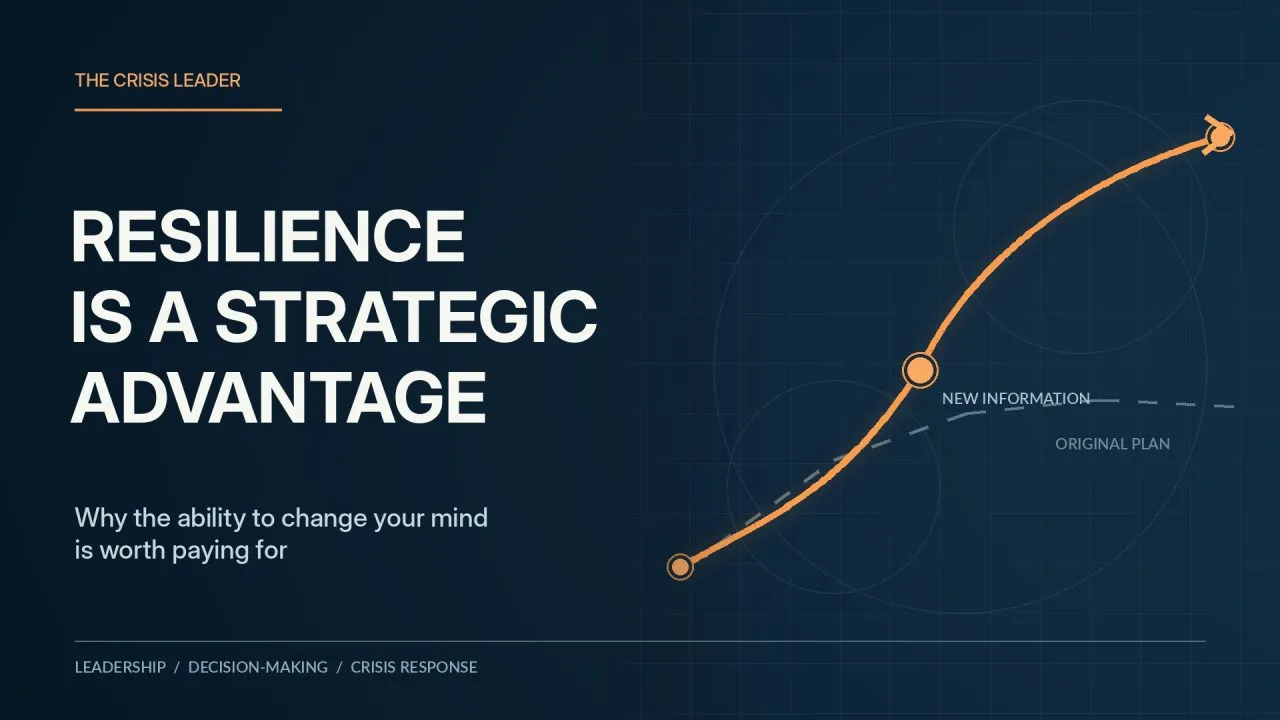
Why the ability to change your mind is worth paying for.
In October 2014 I arrived in West Africa as part of NetHope’s response to the Ebola outbreak. Our task sounded simple enough: help the humanitarian organizations fighting the epidemic stay connected, so they could coordinate their work, share information and, not least, let exhausted responders speak to their families at the end of the day. In practice, almost everything we needed to know was unknown. We did not know where the next cluster of cases would appear, which treatment centers would be built and where, or how long the outbreak would last. Yet decisions could not wait for certainty, because in an epidemic the cost of waiting is paid by the people you are there to help.
So we made decisions with the information we had, and then we changed them as the picture became clearer. We did this deliberately, by design. We started with portable satellite terminals, more than a hundred of them, because they could be carried to remote places and moved again when the need moved. Only when a site had proven it would stay did we invest in fixed satellite installations. As fixed connections replaced the portable ones, the portable terminals were freed up to follow the teams responding to new cases. I remember one point when we had planned to connect a particular site first, and then the outbreak flared up sharply in another location. We revised our priorities and changed the order in which we installed. Nobody had made a mistake in the original plan. The situation had moved, and our plan moved with it. Looking back, what I value most about that phased approach is not that it worked, but how it was designed. It did not try to answer in advance the question of where connectivity would be needed. It kept the right to change our minds as the answer emerged.
Why leaders struggle to change course
Since then I have worked with many leaders, in companies and in government, who find this remarkably hard. They make a decision under pressure, new information arrives, and instead of revisiting the decision they defend it. This is rarely stubbornness. It is usually fear, and not an irrational one. In many organizations a reversal is read as an admission of error, and an admission of error is treated as a failure of leadership. Public-sector leaders face this most sharply, because every change of course can become a headline, an audit finding or a hearing before lawmakers.
Underneath the fear lies a habit of judgment that most of us share. We judge decisions by how they turned out rather than by how they were made. Annie Duke, the former professional poker player who now writes about decision-making, notes that poker players have a word for this: “resulting,” the tendency to equate the quality of a decision with the quality of its outcome. In a crisis, resulting is corrosive. It punishes leaders whose sound decisions were overtaken by events, and it rewards those who were simply lucky. Duke also observes that we do not treat sticking with the status quo as an active decision in the way we treat switching. In my experience, that is exactly how it plays out in a crisis: changing course feels like a choice we will be blamed for, while staying the course feels like no choice at all, even when it is the riskier of the two.
I would put the principle this way. A decision made well with what you knew is a sound decision, even when events later prove it wrong. The question to ask of any past decision is not whether it turned out right, but whether it was made well and whether the leader was willing to revisit it when the information changed. But changing your mind because new information has arrived is not the same as changing your mind because of one bad result. Duke recalls that experienced players warned her against changing her strategy just because a few hands had gone badly. The discipline is to move with the evidence, not with the noise.
The capacity that efficiency quietly removes
Willingness to change your mind, however, is only half of the story. The other half is whether your organization can still act on a changed mind once you have one. Here many institutions have quietly weakened themselves.
The pursuit of efficiency has been one of the great management disciplines of our time, and much of it has been valuable. But efficiency has a hidden cost that rarely appears on a spreadsheet. Each buffer removed, each redundancy eliminated and each early, full commitment made to capture a lower price is also an option given up. A supply chain with a single supplier cannot switch, a budget fully committed in January cannot respond in June, and a team staffed exactly to plan has no one free when the plan changes. In a stable world this is a good trade, because options that are never used are pure cost. But the leaders I work with rarely describe their world as stable anymore, and in the world they do describe, it is a dangerous one.
This is why I believe resilience has been misunderstood. It is usually described as the ability to absorb a shock and recover, but its deeper value is that it preserves choice. The resilient organization can change its mind and act on the change, while its more efficient rivals have already spent the options they would need to do the same.
Paying for the right to change your mind
When I make this argument to boards and finance teams, the objection is usually the same. Resilience is a cost we cannot justify until something goes wrong. It is a fair challenge, and it deserves a direct answer.
You are not paying for a bad day. You are paying for the right to change your mind. Seen this way, resilience is not an insurance premium that sits idle in good years. It is an option that a leader exercises every time new information arrives, and in a crisis new information always arrives. In West Africa, committing early to fixed installations at the first sites we chose would have meant betting everything on a map that kept changing. What we did instead cost very little extra. We did not hold large reserves in idle capacity; we simply committed in a different order, keeping the expensive and permanent decisions until the situation had shown us where they belonged. That, I have come to believe, is the cheapest form of resilience there is. Before an organization pays for spare capacity, it should ask whether it can buy the same freedom simply by staging its commitments.
For leaders, this suggests three practices. First, judge decisions, your own and those of your predecessors, by what was knowable when they were made, and build reviews that learn rather than blame. Second, say in advance what would change your mind. When you announce a decision under uncertainty, also name the signals that would lead you to revisit it. This turns a future reversal from an embarrassment into the plan working as intended. It also gives those who review the decision later, whether a board, an auditor or the public, a record of what was known and what was expected to change. That record is what makes judging by what was knowable at the time a standard of accountability rather than an excuse. Third, protect the capacity to reverse course. Where uncertainty is high and a commitment would be hard to undo, stage it, so that each step buys information before the next one buys certainty.
None of this is easy. It asks leaders to be open about what they do not know, to accept criticism for decisions made in good faith, and sometimes to pay for options they hope never to need. It requires what I think of as composed courage: the calm to decide without full information, and the courage to change course when the information changes. But the organizations that combine that courage with the capacity to act on it will not merely survive the next crisis. They are far more likely to be moving while others are still recovering. That is why resilience is not a cost of doing business. Resilience is a strategic advantage.
For more information check out my book The Crisis Leader.
First published in the The Crisis Leader newsletter on LinkedIn.