AUGMENT: A Ninety-Second Tour
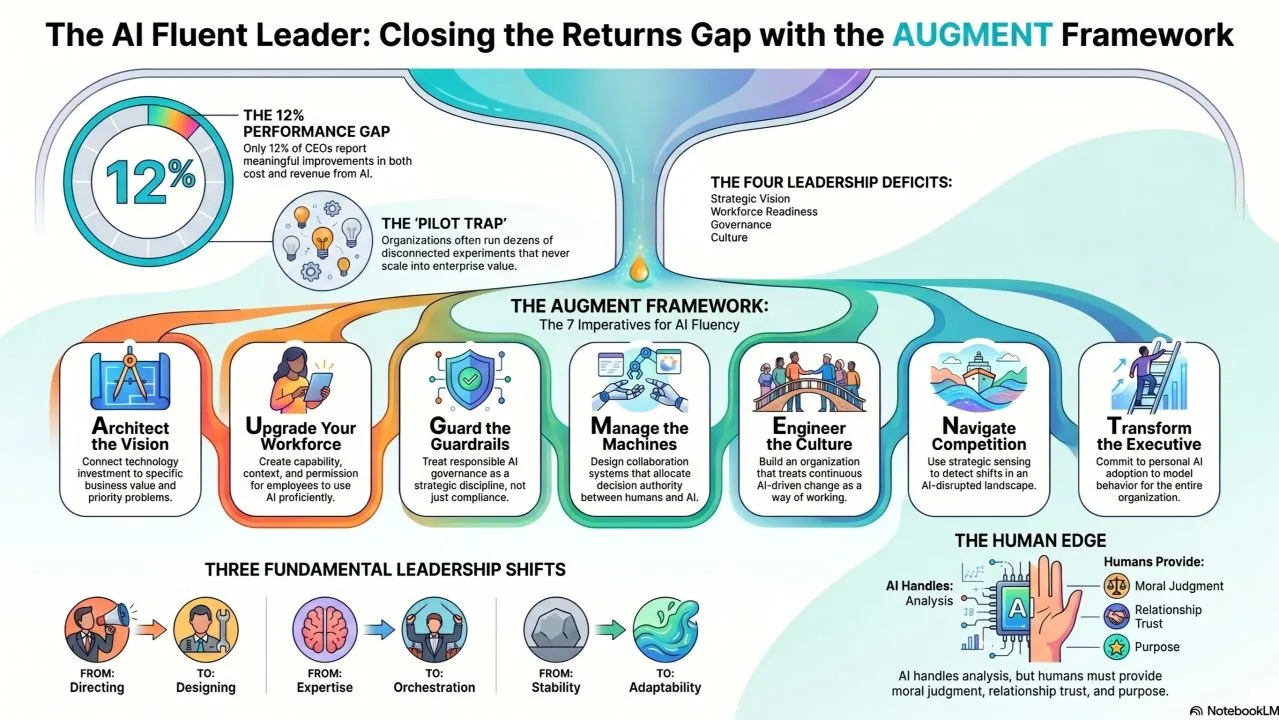
The AI Fluent Leader is built on a working framework called AUGMENT. The book gives a framework, a chapter for each of its seven imperatives, and develops each one at length. For readers who arrived at this writing after the launch, and for readers of the book who want a single page to keep at their desk, here is the ninety-second tour.
AUGMENT names the seven imperatives a senior leader has to hold simultaneously in the AI era. Each imperative is a category of work. Each is necessary. None is sufficient on its own. The framework’s argument is that the leaders who hold all seven at once, even imperfectly, are the leaders whose institutions absorb AI well, and that the leaders who let any one of the seven drop are the leaders whose institutions experience AI as exposure rather than as advantage.
Architect a coherent strategy. The first imperative is to actually have an AI strategy that identifies which decisions the technology makes are relevant. Most institutions have a published AI strategy. Far fewer have a coherent one. The published strategy lists ambitions. The coherent strategy names the specific decisions the institution is making, the ones it is deferring, the ones it is delegating, and the ones it is refusing. The gap between the two is usually where the trouble starts.
Upgrade the workforce. The second imperative is workforce capability building, not training. AI is rendering some capabilities obsolete and rendering others essential. The capability that is becoming most essential is not coding or prompt engineering. It is orchestration: the ability to direct work across human and machine collaborators with a clear sense of what each is good for. Most upgrade programs invest where the noise is loudest. The right ones invest where the institution will need depth in three years.
Guard the institution’s integrity. The third imperative is integrity, which is not the same as compliance. Compliance is the floor. Integrity is the architecture. A senior team can comply with every relevant regulation and still run an AI deployment that erodes the trust the institution relies on. The Guard imperative asks a specific question: would we be comfortable if the way this AI tool actually works within our institution were visible to our customers, our regulators, and our staff simultaneously?
Manage the governance structures. The fourth imperative is governance that does not ossify. The temptation in the AI era is to build governance that is so thorough it freezes the institution, or so light it lets risk through. The right governance has clear decision rights, working escalation paths, and real review cadences. The book includes a decision rights matrix for AI decisions, which is the most-asked-about tool so far.
Engineer the technical foundations. The fifth imperative is the foundation of the AI you can see. Data, identity, observability, and the working conditions of the systems the AI runs on. The Engineer imperative is the one senior leaders most often delegate entirely to a technology function and most often regret delegating. The foundation question is a leadership question, not a technical one, because the cost of skipping it is paid by the institution as a whole.
Navigate the geopolitics. The sixth imperative is the geopolitical reality within which the AI strategy has to operate. Vendor selection has become a question of sovereignty. Data residency has become a procurement question. Supply chains for compute, talent, and components have become a board question. The Navigate imperative asks the leader to hold the geopolitical context in mind alongside the institutional one, even when that context is uncomfortable.
Transform the culture. The seventh imperative is culture, the throughline that runs beneath all six of the others. The cultures that absorb AI well are the cultures that already practice curiosity, candor, and shared accountability. The cultures that absorb AI poorly are the cultures that already practice blame, theater, and information hoarding. AI does not produce the culture. It tests the culture. The Transform imperative is the slowest of the seven, the most undervalued, and the most consequential.
That is the framework on a single page. Architect, Upgrade, Guard, Manage, Engineer, Navigate, Transform.
We built it as seven imperatives rather than one because single-track AI advice has been failing senior leaders. There is plenty of advice on building a strategy. There is plenty of advice on building data foundations. There is much less advice that helps a chief executive hold all seven at once, see where they reinforce each other, and notice the moment any one of them is being underinvested in. AUGMENT is the working frame for that holding.
The AI Fluent Leader is available on Amazon worldwide.
First published in the The AI Fluent Leader newsletter on LinkedIn.