AI Does Not Replace Leaders. It Exposes Them.
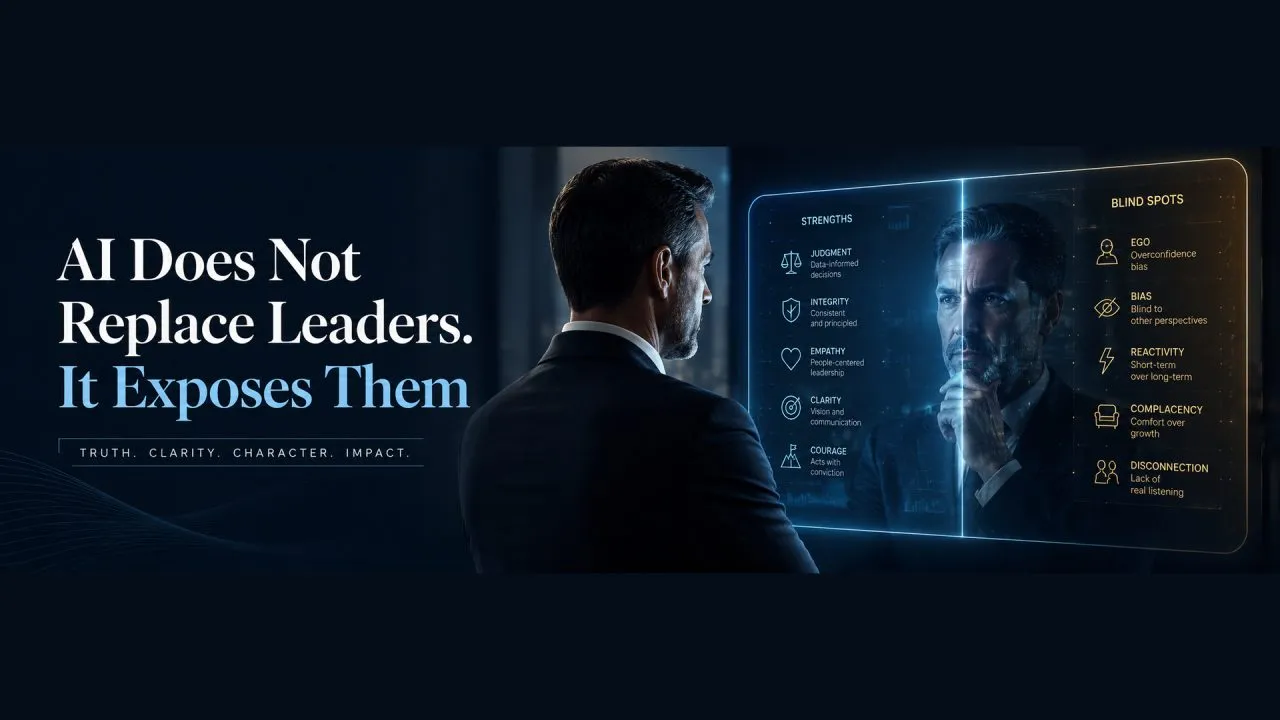
Most of the conversation about artificial intelligence is about what the technology can do. I want to make the case that this is the wrong conversation for a leader to be having, and that the right one is more uncomfortable.
The more time I spend with boards and executive teams, the more convinced I become that AI’s real effect on an institution is not an addition. It is exposure. It does not hand you a new capability so much as it shines a hard light on the capabilities and the leadership you already had.
For most of my working life, I have led institutions under pressure. I spent more than two decades inside companies like Microsoft, and as many years in the field, running technology and command in some of the era’s hardest humanitarian responses: the Haiti earthquake, the West African Ebola outbreak, the Syrian refugee crisis, and the Nepal earthquake. Later, I sat in Iceland’s parliament and then led the national Red Cross society. Different worlds, one constant. Pressure does not change an institution so much as it tells the truth about it.
Artificial intelligence is now applying that pressure to organizations that have never faced it, and it is doing so quietly, from the inside.
Consider what actually happens when a company decides to adopt AI seriously. The first thing it discovers is rarely a technology problem. It is a data problem, which is really a discipline problem: the information the new tools need turns out to be scattered, inconsistent, and ungoverned, because no one was ever held accountable for it. This holds especially true in the humanitarian sector, where data is collected in different formats and hardly archived properly.
The second thing it discovers is a strategy problem: the AI initiative has no honest connection to where the business is actually trying to go, because the strategy itself was thinner than anyone wanted to admit.
The third thing it discovers is a capability problem: people have been sent for training, yet the organization still cannot do the new thing reliably because capability is not the same as training. None of these weaknesses was created by AI. Each was already present. AI simply made them impossible to ignore.
This is why so many AI efforts stall in ways that surprise the people leading them. The pilot works. The demonstration is impressive. And then the rollout fails, and everyone reaches for a technical explanation, when the real explanation is institutional. The pilot succeeded because it was protected, run by a few capable people who were given permission to work differently. The rollout failed because it met the organization as it actually is, with its real governance, its real culture, its real tolerance for people doing new things badly while they learn to do them well. The tool did not change. The conditions did.
I have come to believe that the leaders who will do well in this period are the ones who reverse the usual order of operations. The common instinct is to start with the tooling and work backward to the organization. The better instinct is to start with an honest diagnosis of the organization and only then decide what to build. This is not a comfortable sequence because honest diagnosis surfaces things leaders would rather not see. But it is the only sequence that works, for the same reason that you cannot lead a crisis response by buying equipment before you understand the situation in front of you.
There is a deeper point here about what leadership even is in this moment. For a long time, technology adoption could be delegated. It was a matter for a function, a budget line, a vendor relationship. Artificial intelligence resists such delegation because the questions it raises are not functional. They are questions about judgment, accountability, and trust. Who is allowed to make a decision that an AI system informed, and who is responsible when that decision goes wrong? What are we willing to automate, and what must remain a human act precisely because it is hard? How much of our institutional memory are we comfortable handing to a system we do not fully understand? These are not questions a board can pass down. They are the questions a board exists to answer.
This is the sense in which AI exposes leaders. It does not replace the work of leadership. It makes that work unavoidable. The thin strategy, the uneven governance, the neglected data, the untested capability, these were always the leadership team’s to address. What changes with AI is that they can no longer be deferred, because the technology pressing against them will not wait.
I find this genuinely hopeful, and I want to be clear about why. If the problem were technical, it would belong to someone else, and a leader’s main task would be to choose well among vendors. Because the problem is institutional, it belongs to the people accountable for the institution, which means it is within their power to address. Exposure is not a verdict. It is information. A crisis that reveals a weak supply chain is a gift compared to one that does not, because now you can fix it. An AI initiative that reveals a thin strategy has done you a service if you are willing to receive it as one.
The leaders I have watched handle this well share a particular stance. They are not the ones who move first, and they are not the ones who promise the most. They are the ones who can hold steady long enough to look honestly at what the technology is revealing, name it without flinching, and then act in the right order. They treat AI not as a race to adopt but as a mirror to read. And they understand that the composure required to read that mirror is not a personality trait they were lucky to be born with. It is a capability, and like any capability, it is built before the pressure arrives, not during it.
That is the work in front of us. Not learning the tools, though we should. Not predicting which model will win, though it is interesting. The work is leadership: the unglamorous, consequential business of governing an institution honestly through a period that will not let its weaknesses stay hidden. Artificial intelligence did not ask leaders to do this work. It simply removed their ability to avoid it.
The question I would leave with any board is not “what can this technology do for us.” It is quieter and harder. What is this technology about to reveal about how we are led, and are we ready to look?
First published in the The AI Fluent Leader newsletter on LinkedIn.